Aurica is focusing on technology and services companies because the manager is a growth and expansion fund, in which the transactions carried out do not rely on financial leverage. Aurica’s objective is to obtain attractive returns for investors and, rather than focusing on that deleveraging, it concentrates on companies operating in sectors with tailwinds and with scalable business models so that they can significantly increase their size within 3-5 years. This clear segmentation toward services companies is based on the fact that the manager has identified greater opportunities to achieve significant growth without high investment, as may be the case for industrial-profile companies that must undertake investment in factories or similar assets.
Broadening the focus on services and technology companies, Aurica is currently centered on the following verticals:
- Digitalization and technology: focused mainly on services companies that support digitalization, such as the already divested Babel (IT consulting) and Samy Alliance (influencer marketing), but also current portfolio companies t2ó one (digital marketing), Alquiler Seguro (proptech), and Educa Edtech (online education).
- Health and wellness: a focus on services companies aligned with the senior-care, personal-care, and sports trends. The manager considers these to be defensive sectors in the event of a cycle shift, and areas where Spain is a global leader. The manager currently has one portfolio company, Canitas (veterinary clinics), but expects to increase its presence in these segments over the coming years.
- Business Services: varied B2B services that grow for different reasons, such as the defense and aerospace sector, financial or legal services, as well as the environmental services supporting the energy transition, as was the case with the successful sale of STI Norland (photovoltaic trackers).
Given that Aurica is a fund with a strong focus on growth, it pays special attention to this variable and currently considers three types of growth, addressed according to each company’s circumstances:
- Organic growth: focused on companies with annual growth above 20%. The aim is to replicate the company in new geographies and to maintain significant growth in the geographies where the company was already present.
- Buy & build: combining organic growth in companies that grow 10-20% annually with inorganic growth that increases the company’s value proposition, geographic presence, or customer profile. Through inorganic growth, Aurica helps these companies achieve growth beyond what they would obtain organically.
- Perimeter expansion: replicating a proven concept through new installed capacity; this applies to businesses such as veterinary clinics, food service, agriculture, and the like.
This analysis of sectors and company profiles applies both to the United States and to Spain, the regions on which Aurica is currently most focused.
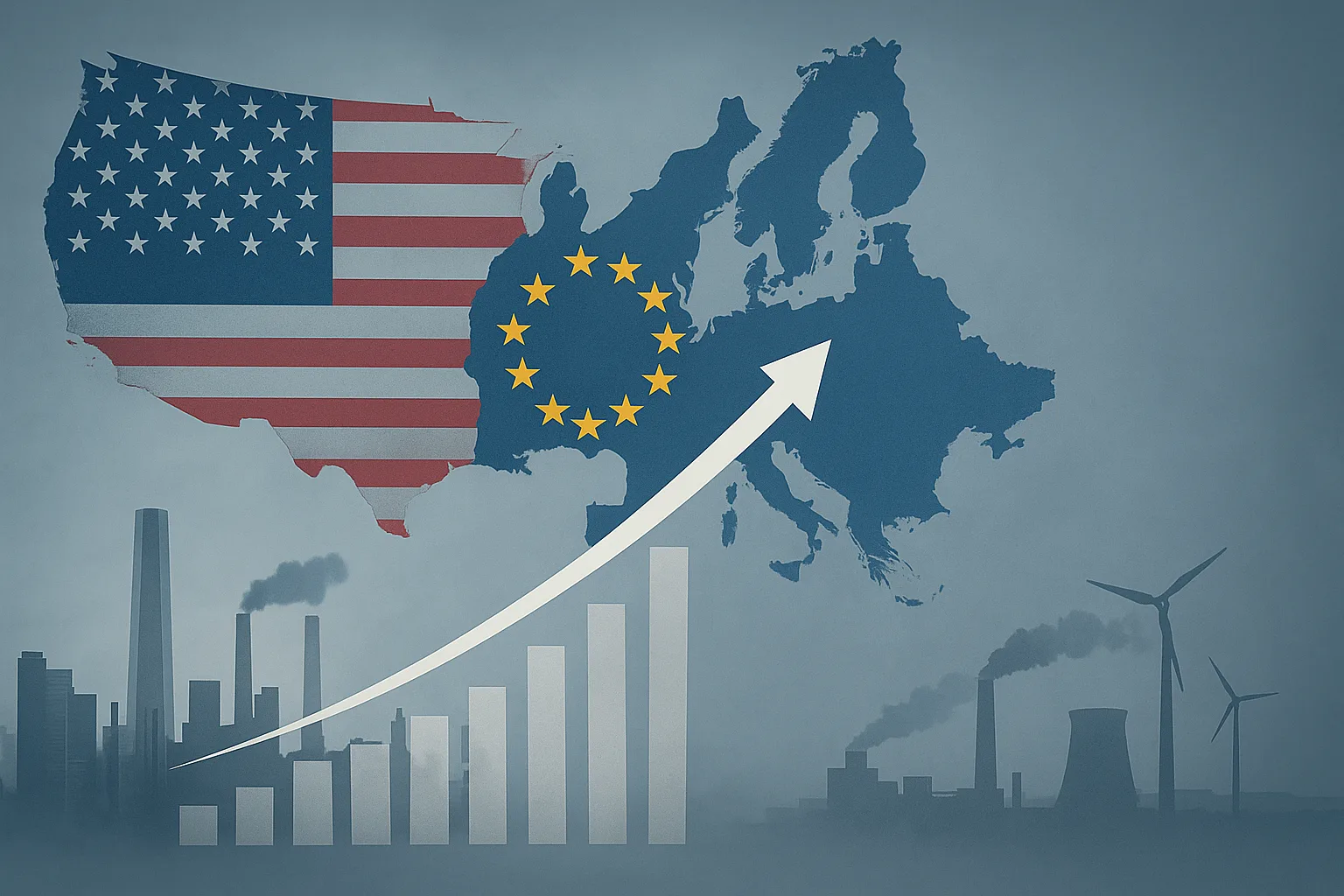
The United States accelerates, Europe reorders, Spain fits in — Aurica Capital analysis team
After more than a decade of cheap money and global supply chains that ran like clockwork, we find ourselves in what appears to be a regime change: harsher geopolitics, tensions along trade routes, and a new technology that promises productivity we cannot yet fully measure while generating new pressures on energy, data, and regulation. At this crossroads, the United States is pressing the industrial accelerator, Europe is reshaping its priorities, and Spain, quietly, is fitting together several pieces that position it better than it was a decade ago.
The world we are leaving behind was governed by three vectors: globalization, low interest rates, and cheap energy. The road ahead is more winding. The armed conflicts in Europe and the Middle East have been a reminder that trade depends on routes that can become blocked. The United States, in a decision that for years would have seemed counterintuitive in the homeland of laissez-faire, has made a political shift toward protectionism, choosing to manufacture again—chips, batteries, electrical components—and to secure its energy and digital backbone. The practical consequence is not a collapse of trade, but a more regional reconfiguration, with less just-in-time efficiency and more just-in-case resilience, which implies cost pressure.
Added to that equation is artificial intelligence. It is hard to ignore its potential to multiply productivity, from more automated factories to professional services that scale with software. However, as investors, it is worth remembering two caveats. First: the benefits arrive with a lag relative to investment in compute, talent, and data. Second: bubbles do not arise from useless technologies, but from disorderly expectations. Against that backdrop, the United States today offers a tailwind that is hard to ignore. It attracts advanced-manufacturing projects and has managed to turn the reshoring narrative into actual construction.
Another U.S. mainstay remains innovation. The density of talent and capital in its technology hubs generates a virtuous circle in which Big Tech, universities, and venture capital feed advances that filter through to the productive fabric. That momentum cannot be replicated overnight.
Europe is following a different path. Several governments have begun to voice what demographers have long repeated: the social model requires more productivity per hour worked and more potential growth on a continent that is aging. That candor, far from being bad news, helps to focus capital on what is essential. When the environment becomes more uncertain, it is wise to invest in what will not change: an aging population that will demand health and care; an economy that is predominantly services-based and SME-intensive; an irreversible commitment to decarbonization and energy independence; and a digitalization that is no longer a trend but a condition of competitiveness. Added to this is a distinctive European feature: fragmented markets where operational discipline and orderly consolidation create value without depending on the cycle.
On that map, Spain has notably improved its relative position. The combination of leadership in renewables, regasification capacity, and a fiber-optic network among the best in Europe has lowered and stabilized key inputs for electricity-intensive industries and digital services. The country has grown above the euro-area average and offers an abundance of opportunities in sectors where growth is structural. The investor’s work lies in the detail: robust governance and compliance to navigate the new protectionism, supply-chain traceability, price-revision capability, and operational integration that creates real value, not just size.
We do not choose the world in which we invest, but we do choose how we do it. Today, the temptation is to debate whether AI is the new electricity or the new bubble, whether protectionism will be temporary or structural, or the expiration date of the various armed conflicts. That conversation is interesting, but it does not deliver sustainable returns on its own. The investor’s agenda involves backing companies that, in this new context, know how to make themselves indispensable. A context in which the United States provides the industrial impetus, Europe reorders its priorities, and Spain, for the first time in a long while, fits in with strengths of its own.